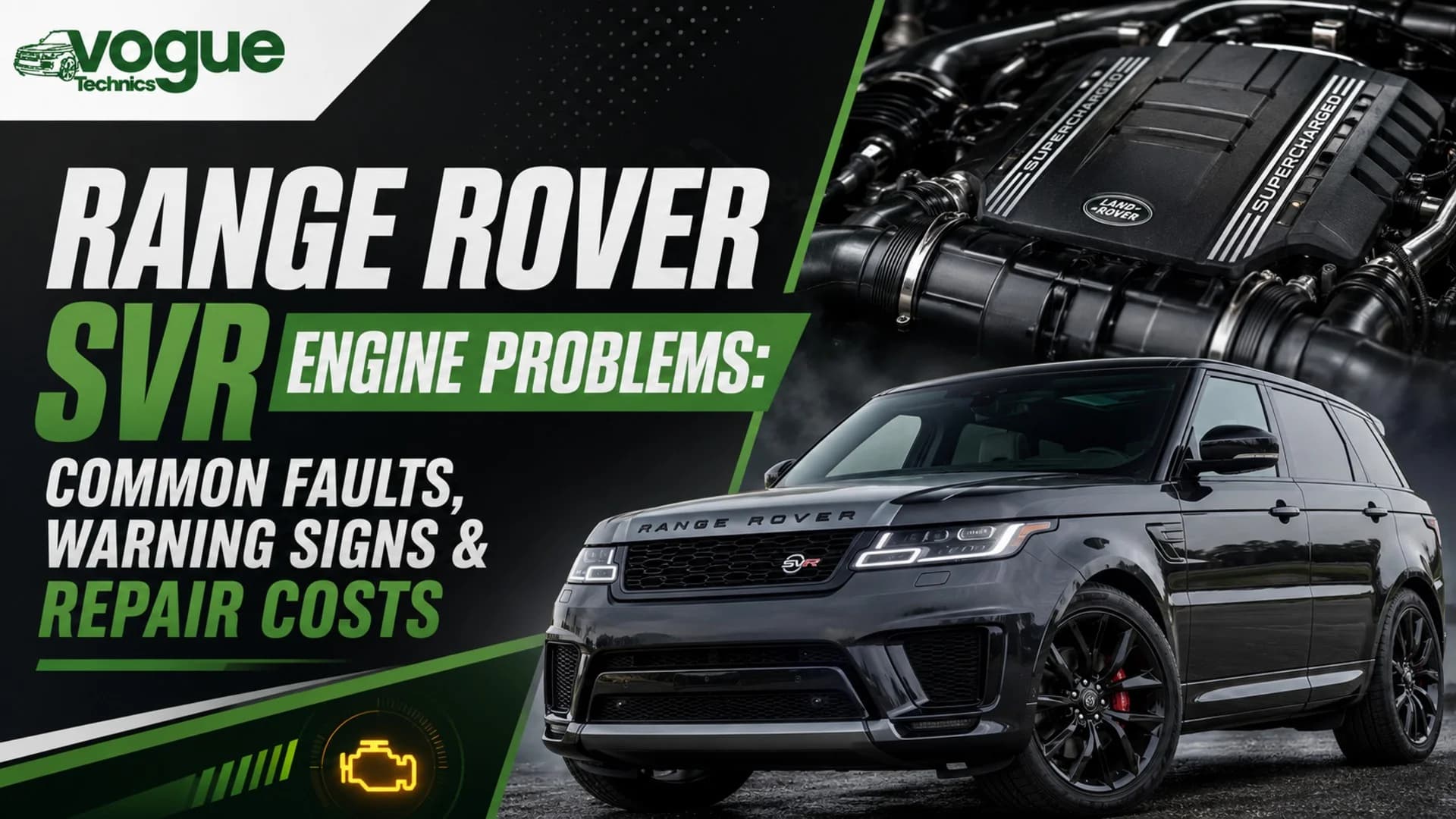
Range Rover SVR Engine Problems: Common Faults, Warning Signs & Repair Costs
That rattle you heard on a cold morning start-up? It's not your imagination, and it's not "just how these engines sound." If you own a Range Rover Sport SVR, or you're eyeing one up on the used market, that noise is often the first sign of a genuine engine problem , and ignoring it can turn a £400 fix into a £9,000 rebuild.
The SVR's 5.0-litre supercharged V8, badged the AJ133, is a phenomenal piece of engineering. It's also one of the more temperamental engines Jaguar Land Rover has ever built. Owners across the UK report the same handful of issues again and again: timing chain wear, supercharger coupler failure, coolant leaks, and oil consumption that seems to defy physics.
This guide walks through exactly what goes wrong, why it happens, what it costs to fix, and how to stay ahead of it , whether you already own an SVR or you're about to buy one.
What Are the Most Common Range Rover SVR Engine Problems?
Before diving into individual faults, it helps to understand the engine itself. The AJ133 is a 5.0-litre supercharged V8 fitted with an Eaton TVS supercharger, producing anywhere from 550 to 575 horsepower depending on the model year. It's shared across the Range Rover Sport SVR, Jaguar F-Pace SVR, Jaguar F-Type SVR, and the limited-run Jaguar XE SV Project 8.
That shared architecture means faults tend to repeat across the range. Here's what turns up most often in workshops.
Timing Chain Wear and Cold Start Rattle
This is the fault most SVR owners will eventually hear about, if they haven't already. The timing chain, along with its guides and hydraulic tensioner, is prone to stretching over time. When the tensioner can't take up the slack fast enough, you get a distinctive metallic rattle on cold start that usually settles once oil pressure builds.
Why Does My SVR Rattle on Cold Start?
The short answer: the hydraulic tensioner needs a few seconds of oil pressure to properly tension the chain, and if the chain has already stretched, that gap widens into an audible rattle. Early on, it might last a second or two. Left unaddressed, that window extends, and the rattle can start happening at idle or under load too , which is a sign the chain guides may already be wearing.
This isn't cosmetic noise. A timing chain that jumps even one tooth on the crankshaft or camshaft sprockets can throw valve timing out of sync, and in the worst cases, causes piston-to-valve contact. That's the difference between a chain replacement and a full engine rebuild.
Supercharger Coupler Failure and Noise
The Eaton TVS supercharger on the AJ133 is bolted directly to the crankshaft via a rubber coupler designed to absorb vibration. Over time , often somewhere between 40,000 and 70,000 miles , this coupler degrades and starts to slip or disintegrate.
You'll typically notice:
- A high-pitched whine or rattle from the front of the engine, most noticeable under acceleration
- Reduced boost and a flat, sluggish feel compared to how the car normally pulls
- In advanced cases, a knocking noise as the coupler breaks apart internally
Left too long, a failed coupler can allow the supercharger pulley to misalign, which puts extra strain on the accessory belt and, in rare cases, damages the supercharger housing itself.
Coolant Leaks, Water Pump Failure and Overheating
The AJ133's cooling system has a few known weak points , coolant pipes, the water pump, and the thermostat housing are the usual suspects. These are often plastic or composite components that become brittle with age and heat cycling, then crack or weep coolant.
Symptoms to watch for:
- A sweet smell inside or around the engine bay
- Coolant level dropping steadily with no visible puddle (often a sign of an internal or slow external leak)
- The temperature gauge creeping up in traffic or on motorway runs
Overheating on a supercharged engine is unforgiving. Where a naturally aspirated engine might tolerate a brief spike, the SVR's forced induction generates significantly more heat, and sustained overheating can warp the cylinder heads or blow the head gasket , a repair that easily runs into four figures.
Oil Leaks and Excessive Oil Consumption
Oil leaks on the AJ133 commonly show up around the valve cover gaskets, oil cooler lines, and sump gasket. On their own, these are usually straightforward and affordable fixes.
More concerning is excessive oil consumption with no visible external leak , often pointing to worn piston rings, valve stem seals, or in some cases, bore scoring. This is one of the more expensive problems to diagnose properly, because it requires more than a visual inspection.
Misfires, Ignition Coils and Carbon Build-Up
Because the AJ133 uses direct injection, it's naturally prone to carbon build-up on the intake valves , fuel doesn't wash over them the way it does in port-injected engines. Over 60,000–80,000 miles, this build-up can restrict airflow and cause rough idle or a noticeable loss of throttle response.
Separately, ignition coils and spark plugs wear out and cause misfires , usually felt as a hesitation under load or a flashing check engine light. This is one of the cheaper problems on this list, but it's often mistaken for something more serious.
How Do You Know If Your SVR Has an Engine Problem? (Warning Signs & Fault Codes)
Catching a problem early is almost always cheaper than catching it late. Here's how to read the signs your SVR is giving you.
Dashboard Warning Signs You Shouldn't Ignore
- Check engine light , never ignore this on a supercharged engine; it can indicate anything from a minor sensor fault to a serious misfire
- Temperature gauge fluctuation , even brief spikes are worth investigating
- Reduced power or limp mode , the ECU pulling power back is a protective response to a detected fault, not a glitch
- Rough idle or vibration at standstill , often carbon build-up or a misfire, but worth checking sooner rather than later
Common OBD-II Fault Codes Explained
If a fault code has already triggered the check engine light, it's worth understanding what it actually means before you panic , or before a garage tries to upsell you on a repair you don't need.
P0016 & P0017 – Timing Chain Codes
These codes relate to the correlation between the crankshaft and camshaft position sensors. In plain terms, the ECU has detected that the timing chain has stretched enough to throw the valve timing out of its expected range. This is one of the clearest early indicators of timing chain wear, and it should be investigated immediately rather than cleared and ignored.
P0420 & P0430 – Catalytic Converter Codes
These codes indicate the catalytic converter isn't performing at expected efficiency. On the SVR, this can be a genuinely worn catalytic converter, but it's also sometimes triggered by an unrelated engine issue , a misfire or oil leak affecting exhaust chemistry , so it's worth a proper diagnostic rather than a straight part swap.
How Workshops Diagnose SVR Engine Faults
A fault code is a starting point, not a diagnosis. A proper inspection typically includes:
Compression Testing
This measures how well each cylinder holds pressure during the compression stroke. Low or uneven compression across cylinders points toward worn piston rings, valve issues, or bore scoring , all of which fault codes alone won't reveal.
Leak-Down Testing
This goes a step further than a compression test by pressurising each cylinder with air and measuring how much escapes, and where. It tells a technician precisely whether a compression loss is coming from the piston rings, the valves, or the head gasket , which matters enormously when deciding between a repair and a full rebuild.
How Much Does It Cost to Fix a Range Rover SVR Engine Problem?
This is usually the question owners actually want answered. Costs vary by workshop, part sourcing, and severity, but here's a realistic picture based on the faults covered above.
These figures reflect independent specialist pricing rather than main dealer rates, which typically run higher.
Engine Rebuild vs. Engine Replacement , Which Is Right for You?
This decision usually comes down to three things: the extent of the damage, the car's overall condition, and how long you plan to keep it.
- Choose a rebuild if the engine block and cylinder heads are sound and the damage is isolated to the timing chain, gaskets, or bearings. It's usually the more cost-effective route and lets you keep the original engine's history intact.
- Choose a replacement if there's significant bore scoring, cracked components, or if a rebuild quote is approaching replacement cost anyway. A reconditioned engine also often comes with its own warranty, which a rebuild may not.
A good specialist will walk you through compression and leak-down results before recommending either route , if a workshop jumps straight to "you need a new engine" without those tests, it's worth getting a second opinion.
Reconditioned/Remanufactured AJ133 Engines vs. New Units
Genuine new AJ133 engines from JLR are expensive and often have long lead times. Reconditioned or remanufactured units , rebuilt to factory tolerances using a mix of genuine and quality aftermarket parts , are the more common and more practical route for most owners. They typically cost 25–40% less than a brand-new unit while carrying a comparable warranty from a reputable supplier.
How to Prevent SVR Engine Problems (Maintenance, Buying Guide & FAQs)
Most of the faults above aren't inevitable , they're accelerated by missed servicing, short journeys, and cheap oil. Here's how to stay ahead of them.
Preventative Maintenance Schedule for the AJ133 Engine
- Every 6,000–8,000 miles: oil and filter change using a fully synthetic oil rated for the engine's viscosity spec
- Every 20,000 miles: cooling system inspection, including hoses, water pump, and thermostat
- Every 40,000–60,000 miles: carbon cleaning to reduce intake valve build-up
- Every 60,000–80,000 miles: timing chain and tensioner inspection, ideally before symptoms appear
- Annually: full diagnostic scan, even with no warning lights, to catch developing fault codes early
Sticking to shorter oil change intervals than the manufacturer's default schedule is one of the single most effective things an owner can do , supercharged engines put more strain on oil than naturally aspirated ones, and it degrades faster than the dashboard service reminder assumes.
Pre-2018 vs. Post-2018 SVR Engines , Reliability by Model Year
Land Rover made running revisions to the AJ133 across its production life, and reliability isn't identical across every year.
- Pre-2018 facelift models are more commonly associated with timing chain and supercharger coupler issues, partly because they've simply covered more miles and partly due to earlier component specifications.
- Post-2018 models benefited from updated coolant pipe materials and some revised gasket specifications, which reduced (but didn't eliminate) coolant leak complaints.
Neither generation is problem-free, but a well-documented service history matters more than the model year alone when judging an individual car.
Used Range Rover SVR Buying Checklist
Before buying a used SVR, whether privately or from a dealer, work through this list:
- Listen for a cold start rattle , ask to see the car before it's been started that day, not after it's already warmed up
- Request the full service history and check oil change intervals specifically, not just stamps in a book
- Ask for a recent diagnostic scan or bring a code reader , check for stored or pending fault codes, even if the check engine light isn't currently on
- Check coolant level and condition, and look underneath for any staining around hoses and the water pump
- Budget for an independent pre-purchase inspection, including a compression test, rather than relying on a visual check alone
A car with slightly higher mileage and a genuine, consistent service history is almost always a safer buy than a lower-mileage example with gaps in its paperwork.
Frequently Asked Questions
How Long Does an SVR Engine Last?
With consistent maintenance , particularly regular oil changes and early attention to timing chain wear , the AJ133 can comfortably reach 100,000 miles or more. Engines that fail earlier than this are almost always linked to missed servicing rather than an inherent design flaw.
What's the Most Expensive Repair on an SVR?
A full engine rebuild or replacement, typically triggered by advanced timing chain damage or bore scoring, is by far the costliest repair, often running from £6,000 to £12,000 depending on the route taken.
Should I Buy an Extended Warranty for My SVR?
Given the cost spread between a minor repair and a full rebuild, an extended warranty can be genuinely worthwhile , provided it explicitly covers the engine and supercharger, and isn't riddled with exclusions for wear-and-tear items, which is where many owners get caught out.
When Should I Book a Professional Inspection?
If you've noticed any of the warning signs covered above , cold start rattle, coolant loss, reduced power, or a stored fault code , it's worth getting the car properly assessed before the issue escalates. A compression and leak-down test will tell you far more than a warning light ever will, and catching a problem at the timing chain stage is a very different conversation to catching it after bore scoring has set in.
Final Thoughts
The Range Rover SVR is a genuinely brilliant car to drive, but the AJ133 engine rewards owners who stay ahead of its known weak points rather than reacting to them. Timing chain wear, supercharger coupler failure, and coolant system leaks aren't rare exceptions , they're well-documented patterns, and catching them early is consistently cheaper than catching them late.
If you own an SVR and you've noticed any of the warning signs above, or you're about to buy one and want peace of mind before you commit, it's worth having it properly inspected by specialists who know this engine inside out. Voguetechnics, based in Grays, Essex, carries out full diagnostic assessments , including compression and leak-down testing , specifically for Range Rover and Jaguar SVR models, so you know exactly what you're dealing with before it becomes a bigger bill.